Guide / 8 min read / AI campaign strategist
AI Campaign Strategist: From One Line to a Full Brief
An AI campaign strategist turns a one-line email request into a real brief: audience, goal, sections, and CTA, without inventing offers. Here's how it works.
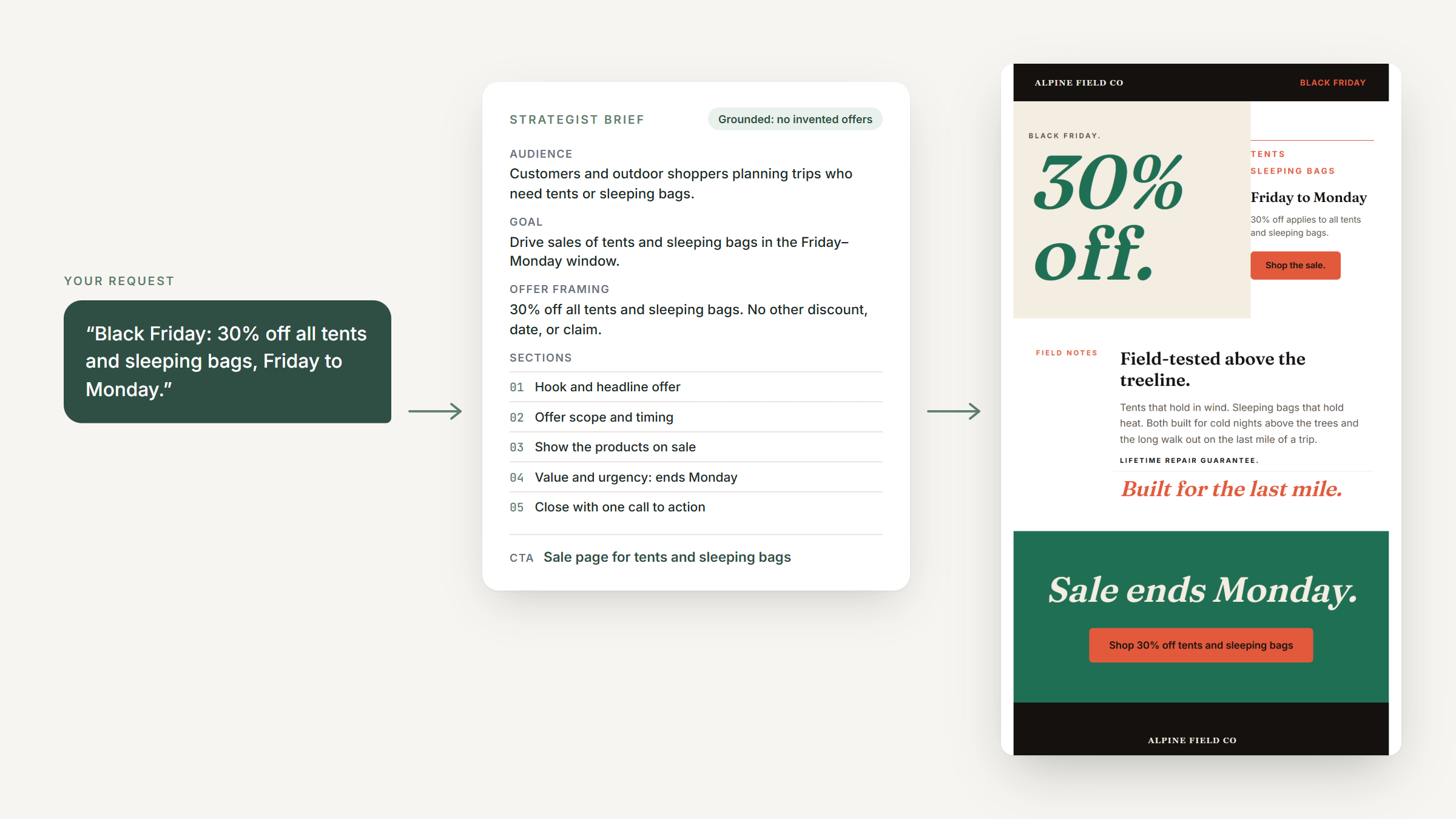
Most AI email tools jump straight from your prompt to a design. Type "Black Friday email" and you get a hero, a discount badge, and a button. The layout is fine. The thinking behind it is missing. Nobody decided who the email is for, what it must achieve, or what each section is there to do.
That missing step is the campaign strategist's job. In a human team, a strategist turns a vague request into a brief before anyone opens a design tool. An AI campaign strategist does the same thing in seconds, and it is the difference between an email that looks finished and an email that is built to convert.
What does a campaign strategist actually do?
A campaign strategist owns content strategy, not visuals. Before a single block is placed, they answer five questions:
- Audience. Who is this email for, in plain words? New subscribers, lapsed buyers, and VIPs need different emails.
- Goal. What is the one thing this email must achieve? Not three things. One.
- Offer framing. How should the value be presented? Urgency, exclusivity, newness, or helpfulness.
- Sections. What must each part of the email accomplish, in order? A hook, proof, product, reassurance, action.
- Call to action. Where does the main button take the reader, and why should they click now?
None of these answers mention colours, fonts, or layout. That is deliberate. Strategy decides what the email says and why. Design decides how it looks. When one person or one prompt tries to do both at once, the strategy usually loses, because visual decisions are easier to see.
Teams that get this right earn more from email. In the Litmus State of Email 2026 data, 36% of teams earning 36:1 ROI or more report advanced AI adoption, with AI deeply built into their email workflows and decision-making, against 23% of lower-ROI teams. Using AI for decisions, not only for copy, is the gap.
Why do short prompts produce generic emails?
A short prompt leaves every strategic decision open. The model fills those gaps with the most common pattern it has seen. For "Black Friday email", that pattern is a big percentage, a countdown, and "Shop now". It looks like every other Black Friday email because, statistically, it is every other Black Friday email.
Short prompts are not the user's fault. Marketers are busy, and "welcome email for new subscribers" is a perfectly reasonable thing to ask for. The fix is not to make people write longer prompts. The fix is a step that does the strategic thinking for them, in the open, before design starts.
How does an AI campaign strategist work?
In Letro, every new email starts with a strategist pass. It works in one of two modes, based on how much you wrote.
Expand mode, for short requests. If your prompt is short and generic, the strategist expands it into a full content brief. It picks the email type, names the audience, sets a single goal, and writes three to six section beats, each with a purpose and a content directive for the designer.
Distill mode, for detailed requests. If you pasted a full brief, the strategist does the opposite. It does not add sections or "improve" your plan. It restates what you asked for in a structured form, keeps your specifics word for word, and drops styling instructions so they do not fight with the design pass.
The strategist skips itself when it has nothing to add, for example when you are refining an existing email in the same chat.
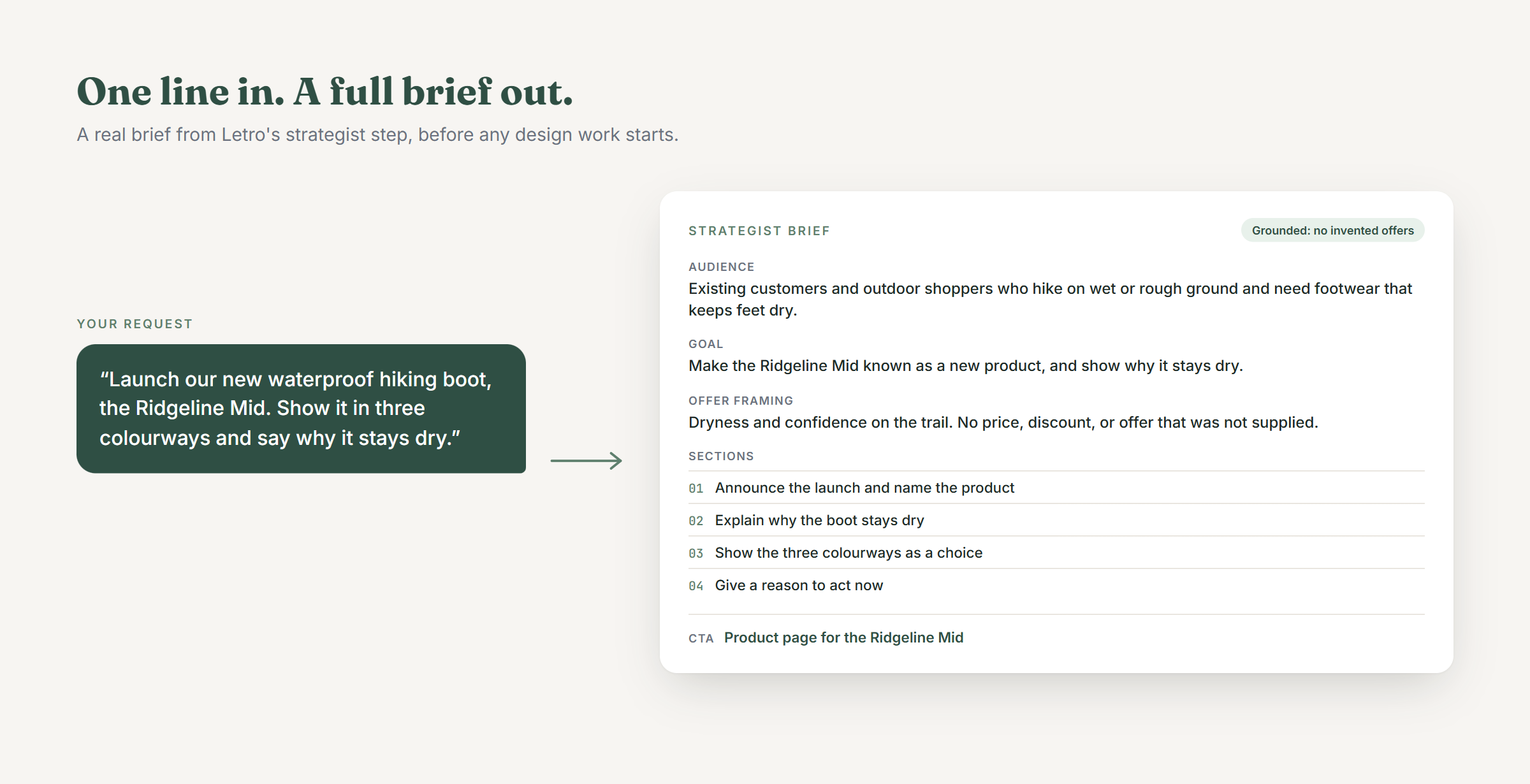
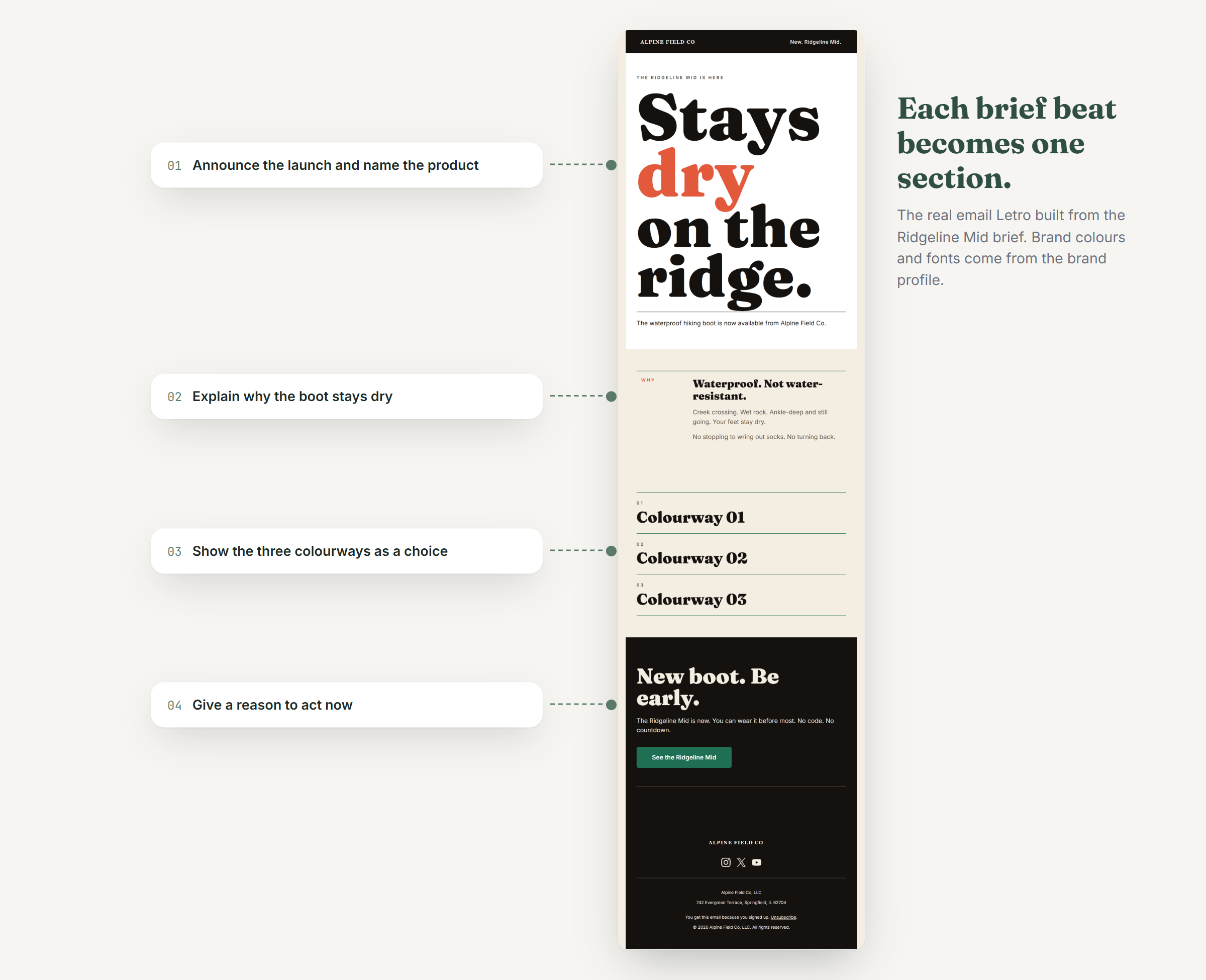
Here is a real brief, lightly shortened, that Letro's strategist wrote for an outdoor brand. The whole request was: "Launch our new waterproof hiking boot, the Ridgeline Mid. Show it in three colourways and say why it stays dry."
| Brief field | What the strategist wrote |
|---|---|
| Audience | Existing customers and outdoor shoppers who hike on wet or rough ground and need footwear that keeps feet dry |
| Goal | Make the Ridgeline Mid known as a new product, and show why it stays dry |
| Offer framing | Dryness and confidence on the trail. Do not add any price, discount, or offer that was not supplied |
| Section 1 | Announce the launch and name the product. Do not invent a launch date |
| Section 2 | Explain why the boot stays dry, using only the waterproof claim and any detail in the knowledge base |
| Section 3 | Show the three colourways as a choice. Do not invent colourway names |
| Section 4 | Give a reason to act now: the boot is new. No invented urgency or discount |
| Call to action | The Ridgeline Mid product page, using the store URL from the brand context only |
Notice what is not there: no colour, no font, no "full-width hero image". A separate creative pass owns those. The brief tells the designer what each section must do, not what it must look like.
The grounding rule: never invent the offer
The most dangerous thing an AI can do in email is make up a fact. A fabricated "30% off" or "free shipping over $50" in a sent campaign is a customer-service problem, and in some markets a legal one.
So a good AI campaign strategist follows one hard rule: products, prices, claims, and offer details come only from you. That means your prompt, your knowledge base, or your brand profile. If a specific is missing, the strategist writes a directive instead ("feature three bestselling products") rather than a made-up specific ("Linen Shirt, $49").
Your own words always win. If your prompt says "20% off this weekend", the 20% stays exactly as written. It is never rounded, upgraded, or "made punchier".
This is why strategy and copy should be separate steps. A model asked to "write a persuasive Black Friday email" is rewarded for persuasion, and inventing a bigger discount is persuasive. A model asked only to plan the email, with an explicit rule against invented specifics, has no reason to make anything up.
AI campaign strategist vs. AI copywriter
They sound similar. They do different jobs.
| AI campaign strategist | AI copywriter | |
|---|---|---|
| Main output | A content brief: audience, goal, section beats, CTA | Finished copy: subject line, headline, body text |
| When it runs | Before design, once per new email | After the layout exists, per text block |
| Short prompts | Expands them into a full plan | Writes generic copy from them |
| Invented offers | Forbidden: missing facts become directives | A real risk unless you check every line |
| Owns visuals | No: layout and styling belong to the design pass | No |
You want both. The strategist decides what the email needs to say. The copywriter, or the design pass, says it well.
How to get better results from an AI campaign strategist
The strategist is only as good as the context it can read. Four things make the biggest difference:
1. Set up a brand. A brand profile gives the strategist your tone, your positioning, and what makes you different. Without it, the "story" section has nothing true to draw on. In Letro, this lives under Brand.
2. Upload real product and offer facts. Put your catalog, current offers, and shipping policy in the knowledge base (Brand → Knowledge). The strategist can then name real products instead of writing "feature three products".
3. Put the one fact that matters in the prompt. You do not need a long prompt. You need the specific: "Black Friday, 25% off sitewide, ends Monday midnight." The strategist builds everything else around it.
4. Write a full brief when you already have one. If your team already decided the sections, paste them. Distill mode keeps your plan exactly as written, in your order.
Who is an AI campaign strategist for?
Solo founders and small DTC teams. You do not have a strategist on staff. You need emails that are planned like an agency would plan them, without the agency.
Busy marketers who write short prompts. You know what you want but do not have time to write a full brief for every send. The strategist writes it for you, and you can still see and adjust the result.
Agencies producing many brands. A consistent planning step means every client email starts from a real brief, not from whoever wrote the prompt that day.
If you already have a strategist and a full brief for every send, the value is smaller but not zero: distill mode makes sure the design pass follows your plan instead of reinterpreting it.
FAQ
What is an AI campaign strategist?
An AI campaign strategist is an AI step that plans an email before it is designed. It turns a request into a content brief: who the email is for, the one goal, how to frame the offer, what each section must do, and where the call to action leads.
Can an AI campaign strategist invent discounts or prices?
It should not. A well-built strategist only uses offers, prices, and product names from your prompt, knowledge base, or brand profile. When a fact is missing, it tells the designer what to include ("feature three bestsellers") instead of making one up.
Do I need to write a long prompt?
No. Short prompts are exactly what the strategist is for. Give it the one fact that matters, such as the offer and the deadline, and it plans the rest. If you do have a detailed brief, paste it, and the strategist will keep it as written.
Is an AI campaign strategist the same as an AI copywriter?
No. A copywriter writes the words. A strategist decides what the email must say, to whom, and in what order. In Letro, the strategist runs first, and the design pass writes the copy from its brief.
Does the strategist decide the design?
No. It owns content strategy only. Colours, fonts, imagery, and layout come from your brand and a separate creative pass, so the plan and the look do not compete.